

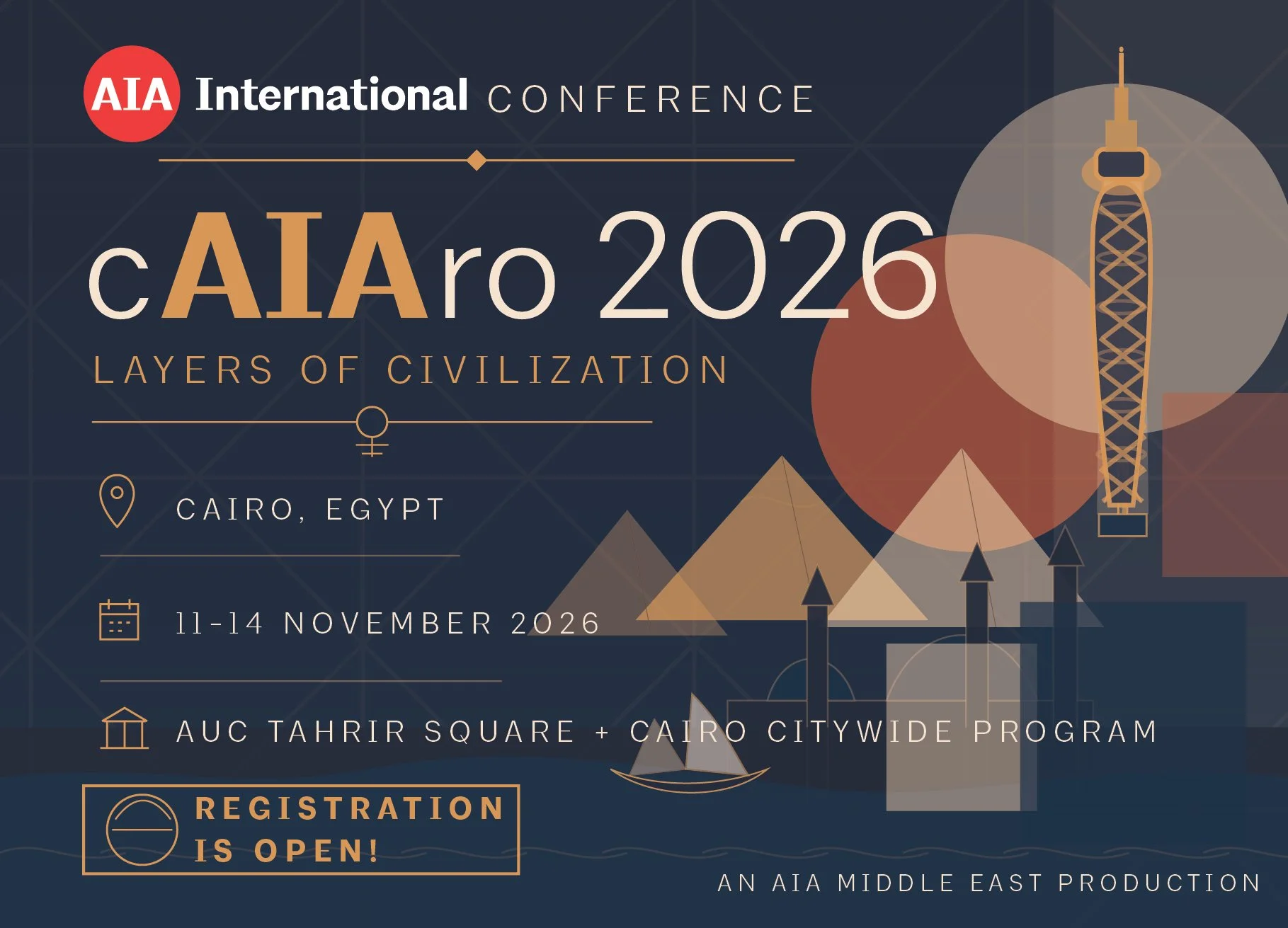
Cairo is a city built in layers. Across three days of talks, site visits and architectural tours, cAIAro 2026 explores how successive civilizations have shaped the city—and how architects today negotiate the relationship between heritage, identity, contemporary practice and the future.
The program moves deliberately between discussion and experience: from the American University in Cairo to the Pyramids of Giza and Grand Egyptian Museum; from the churches of Coptic Cairo to the mosques, houses, streets and public spaces of Islamic Cairo.
Thursday, Novermber 12
Carriers of Civilization—Baghdad, Cairo, Dubai
Raya Ani, FAIA, Founder and Design Director, RAW-NYC Architects
Opening cAIAro 2026, Raya Ani considers three cities shaped by very different moments in the history of the Arab world. Through Baghdad, Cairo and Dubai, the keynote explores how cities carry culture forward—and how contemporary architecture can respond to history, identity, climate and rapid urban transformation without resorting to imitation.
Building Continuity: Translating the Grand Egyptian Museum from Design Intent to Constructed Reality
Dina Ghobara, Senior Architect and Sustainability Coordinator, Pace
Ahead of the conference visit to the Grand Egyptian Museum, Dina Ghobara offers an inside perspective on translating one of the world’s most ambitious cultural projects from architectural vision into built reality. Drawing on her experience as part of the GEM construction team, the session examines multidisciplinary coordination, environmental performance, BIM, building systems and the technical demands of creating a contemporary museum alongside the Giza Plateau.
Engineering Monumentality: The Pyramids, Sphinx and Giza Plateau
The first architectural tour brings participants face-to-face with architecture at its most elemental and enduring. At the Giza Plateau, the Great Pyramids and Sphinx become the setting for exploring structure, construction, material, geometry, landscape and monumentality—as well as the contemporary challenges of conserving and interpreting one of the world’s most significant archaeological sites.
The Grand Egyptian Museum: Architecture, Conservation and Interpretation
From ancient monumentality to one of Egypt’s most important works of contemporary architecture, the program continues at the Grand Egyptian Museum. The visit examines the building as both architecture and complex cultural infrastructure, exploring visitor movement, accessibility, environmental control, building systems, conservation and the relationship between the museum, its collections and the Giza Plateau.
The day concludes with the Pyramids Sound & Light Show.
Friday, November 13
Sacred Continuity—Mosque Architecture from Madinah to Cairo and Dubai
Nirmeen Abu Lughod, Dr. Hadeel El Naggar and Rajagopalan Palamadai, Intl. Assoc. AIA
How does sacred architecture evolve while retaining cultural and spiritual continuity? This session considers the mosque across different periods and places, examining how typology, climate, material, technology and social context influence architectural expression. Rajagopalan Palamadai adds a perspective on the work and legacy of Hassan Fathy.
Heritage Under Pressure—Activism, Inequality and the Changing City
Sanmita Patel, Prof. Abdelmohsen Farahat and Dr. Nagia Said
Heritage is not static. It exists within cities experiencing demographic change, development pressure, environmental stress and competing ideas about what should be preserved. This session examines the relationship between cultural heritage, social equity and urban transformation—and the role architects, researchers and communities can play in shaping the future of historic places.
Narrating Cairo—Literature, Memory and the Lived City
Sarah Abdel-Monim and Roba Youssef, Assoc. AIA
Cairo exists not only in buildings and streets, but also in memory, literature and the stories of those who inhabit it. This session examines how cultural narratives shape our understanding of the city and asks how architects might translate memory, identity and lived experience into meaningful contemporary design.
Cultural Memory as Design Evidence
Dr. Maria A. El Helou and Dr. Ibrahim Saad
Can memory itself become a form of design evidence? Bringing together perspectives from neuroarchitecture, human-centered design and digital interpretation, this session explores how identity, memory and human experience can inform architectural decisions—and how emerging tools can help designers interpret cultural context rather than merely reproduce its visual language.
Designing the Next Layer: Cultural Continuity in Contemporary Practice
Andrija Stojic, WHY Architecture; Carolina Godinho, Perkins Eastman; Tomasz Wozny, Foster + Partners
The closing plenary turns the conference toward the future. Three practitioners working across architecture, cultural projects, urban design and major contemporary development consider how new interventions can become the next layer of cities with complex histories—responding to place and cultural identity while meeting the changing environmental, social and technical demands of contemporary practice.
Coptic Cairo: Sacred Architecture and Adaptive Continuity within the Fortress of Babylon
Within the walls and remains of the ancient Fortress of Babylon lies one of Cairo’s richest concentrations of religious architecture. This guided architectural walk explores the layered development of Coptic Cairo through the Hanging Church, Church of St. Sergius and Bacchus and the Church of the Holy Family Dwelling, examining sacred space, material, adaptation and the extraordinary continuity of a living religious precinct within an ancient urban fabric.
The day concludes with an Evening Nile Cruise.
Saturday, November 14
Mosque, Madrasa and Domestic Architecture—Sultan Hassan, Ibn Tulun and Gayer-Anderson
Three remarkable buildings reveal very different dimensions of historic Cairo.
The monumental Mosque and Madrasa of Sultan Hassan demonstrates the relationship between religious architecture, civic presence and structural ambition. At the Mosque of Ibn Tulun, participants explore one of Cairo’s most distinctive mosque typologies, including its material expression and passive environmental strategies. The Gayer-Anderson Museum shifts the scale to domestic architecture, revealing how courtyard houses responded to climate, privacy and everyday life and how historic buildings have been adapted for contemporary use.
The Layered Public Realm of Islamic Cairo
Beginning at the Citadel of Saladin and Mosque of Muhammad Ali, the afternoon traces Cairo from monumental architecture into the fabric of the living city.
The journey continues along Al-Muizz Street and into Khan El-Khalili, exploring how architecture, streets, markets, monuments and public space have accumulated over centuries. Rather than treating Historic Cairo as a collection of isolated monuments, the tour examines it as an evolving urban environment where conservation, commerce, pedestrian movement and contemporary life continue to overlap.
This event is organised by AIA Middle East and AIA International. We reserve the right based on reasonable assessment of the circumstances to exclude individuals who display unprofessional or disruptive behaviour. AIA Middle East, AIA International, its programmers and moderators can and will select those questions and comments they deem pertinent to the talk and program.
By registering for this event, you consent to the use of your name and image (in any format) for AIA International and AIA Middle East advertising, promotional, and public relations purposes (including newsletters, web pages, social media, brochures, and recordings). To waive your consent, you must inform AIA International in writing at administrativedirector@aiainternational.org no later than 5 days after the event.